passist
Passing siteswap assistant, by Christian Helbling
Many passing pattern, animated and described in Sitswap, Prechac and Words.
Passing diagram is shown.
An animation is shown.
There is also a passing Generator.
Figures with 1, 2, 3, 4 or more persons.
In the siteswap, the number -1 gives the number of objects thrown before the object is thrown again.
E.g. : 3 means 2 objects are thrown before the club is thrown again.
For begginers : 744 with 5 clubs is easy. Instead of the "flip", hold just the club in the hand.
I don't know which notation tels to hold a club in the hand (without flip).
After 9 comes a instead of 10 ; b instead of 11, etc.
I think normal 2 count and four count juggling cannot be simulated,
since the thrown are synchronous.
Go Juggle
A collection of mini apps for exploring Siteswaps and the mathematics of juggling.
Juggling Algorithms & Mathematics - siteswap swiss army knife, by Ali Gottschall.
Other information about juggling
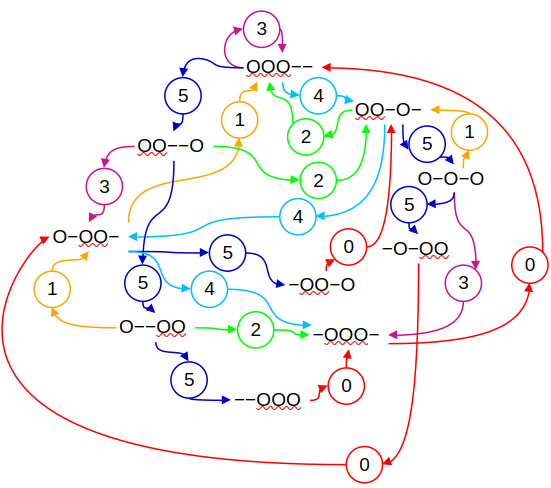
3-ball juggling state diagram, with rhythms ranging from 0 to a maximum of 5.
This diagram is similar to the one shown in the “Siteswap Graph” on Ali Gottschall’s webpage.
With "Props = 3" and "Max height = 5".
‘1’ indicates the presence of a ball.
‘0’ indicates the absence of a ball.
The number corresponds to the ‘height’ of the throw,
more specifically, the time it takes for the ball to return to a hand.
‘Even’ => returns to the same hand.
‘Odd’ => returns to the other hand.
Throws are made alternately with one hand, then the other.
An ‘O’ represents the presence of a ball in the hand.
A ‘-’ represents the absence of a ball in the hand.
“OOO--” represents the normal juggling state of a 3-ball routine.
On the right, an unlimited number of dashes could be added, representing moments when balls may arrive.
The symbol on the left disappears and an “O” appears on the right at the moment represented by the number in the circle.
Translated with DeepL.com (free version).
Voir la version française :
Diagramme d'états de jonglerie à 3 balles, avec des rythmes de 0 à 5 au maximum.
Ce diagramme est similaire à celui représenté dans le "Siteswap Graph" de la page Web de Ali Gottschall.
Avec Props = 3 et Max height = 5.
"1" correspond à la présence d'une balle.
"0" correspond à l'absence d'une balle.
Le chiffre correspond à la "hauteur" du lancer,
plus précisément au temps que la balle met pour revenir dans une main.
"Pair" => revient dans la même main.
"Impair" => revient dans l'autre main.
Les lancers se font alternativement une main, puis l'autre.
Un "O" représente la présence d'une balle dans la main.
Un"-" représente l'absence de balle dans la main.
"OOO--" représente l'état normal de jonglerie d'une cascade à 3 balles.
À droite, on pourrait ajouter un nombre illimité de traits, qui représentent des instants où des balles peuvent arriver.
Le symbole de gauche disparaît et un "O" apparaît à droite, à l'instant représenté par le nombre dans le cercle.
 soft_others.html